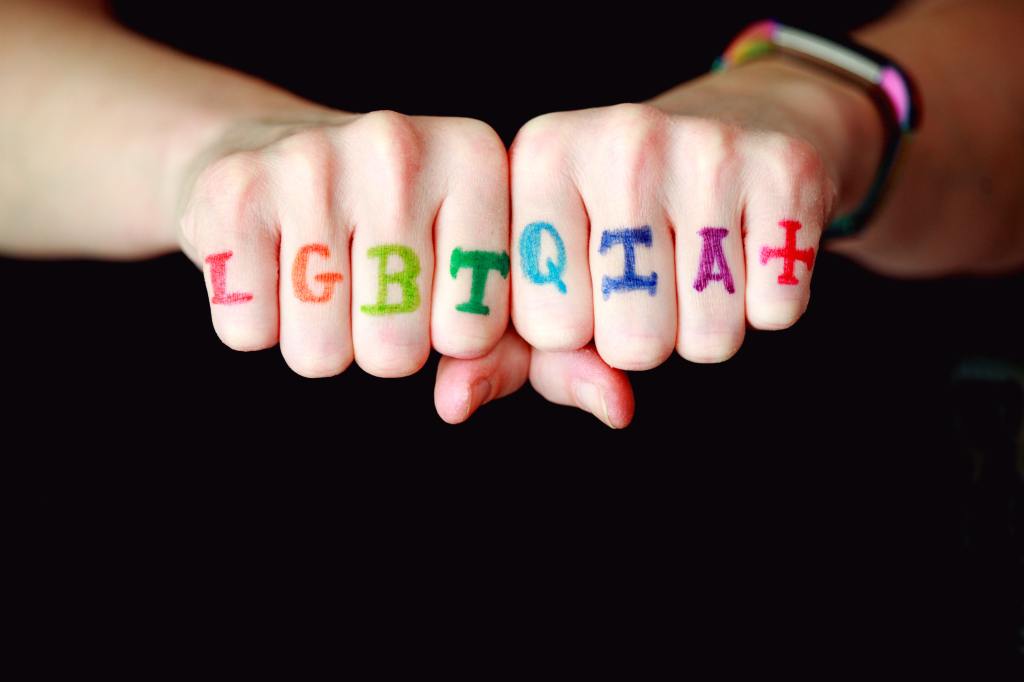
A brief overview of the language I’m using in this research.
Going back to my days in secondary school I was always interested in the words people used to describe themselves and the world around them. That’s not to say I had an aptitude for language; far from it as my French teacher would DEFINITELY agree! But how people use language to manifest the descriptions of particular ideas always interested me. Perhaps that’s why I chose to study philosophy at undergrad, or why I eventually made my way into social science.
When it comes to labels, the LGBTQIA+ community has long had a love/hate relationship with them. The language used to describe us as a group has changed and developed over time. For some, delving deep into the minutiae of identity is critical for understanding who they are, who is part of their community and how to navigate through life. For others, the idea of any kind of ‘label’ is abhorrent, flying in the face of individualism and inclusion which is a mainstay of the community.
There can be a fluidity to language use too – for a long time I identified strongly as lesbian, then I began to use the simpler ‘gay’ to describe myself. Now, as I grow older and have an appreciation that nothing remains fixed, I much prefer the term queer. For me, it encompasses a far greater reach than sexuality or sexual orientation; the idea of ‘queer’ is to challenge, to ‘disrupt’ and to trouble. ‘Queers’ is anti-assimilationist in many ways.
However, I do understand that for many in our community the word ‘queer’ can be hurtful; for other it is a symbol of pride and of empowerment. I have chosen to use the word queer in the title of my study for two reasons.
It is my own personal preference to describe myself. As a member of this community, and as someone who is a former family carer for a number of different family members over time, I am embedded ninths research – I am what they call an ‘insider’. I am being as transparent as possible about that.
It is more manageable, and encompasses more people and identities that either LGBTQIA+ or the shorter, but somewhat more benign ‘sexual and/or gender minorities’.
An excellent introductory article on Medium.com includes a brief history of terminology and notes that although there are many different preferences that we all have when it comes to how we are described, that language use must be seen as diverse, and without any kind of hierarchy of merit.
There is not now, nor has there ever been, a consensus on approaches to activism within the LGBTQ community, including the politics of language. LGBTQ people are as diverse and varied as any other group. What unites us is a shared experience of being gender and sexual minorities, though the particularities of that experience differ from person to person. The point is not to position some versions of the initialism as “wrong” and others as “right.” Rather, it is to encourage critical thinking around language as a vehicle of social change, and to recognize that people do not have to agree on all things to work communally. Language ideally brings us together, not divides us. We should not exclude others for using terminology we may not agree with or prefer, or for taking a different approach. We should, however, think critically about the words we use and if they are actually serving their intended purpose, or creating additional problems.
I’m always interested to hear what other researchers and members of the community are using; it’s easy to stay stuck inside a bubble where everyone uses the same language, the same assumptions, the same everything. Within my Doctoral research I will be going into these debates in much more detail, critiquing them, and before I finalise my thesis this language choice may change. I’ll keep you informed!
It’s almost June 2021, and after a long time preparing, thinking… rethinking… I’m finally getting ready to open up data collection!
It’s been a long road to get to this point, and I’m really hoping that there will be a good take-up and response rate for this research.
My overall aim is to try and understand what the experiences are of family carers who are part of the Queer community (AKA the LGBTQIA+ community; AKA the Alphabet Mafia; AKA Sexual and Gender Minorities (SGM); AKA lots of other terms that I hope to critically investigate!) when it comes to services, supports and their sense of identity. Very little attention has been placed on understanding or even including our community in research like this – so it’s important to me to get it as right as I can.
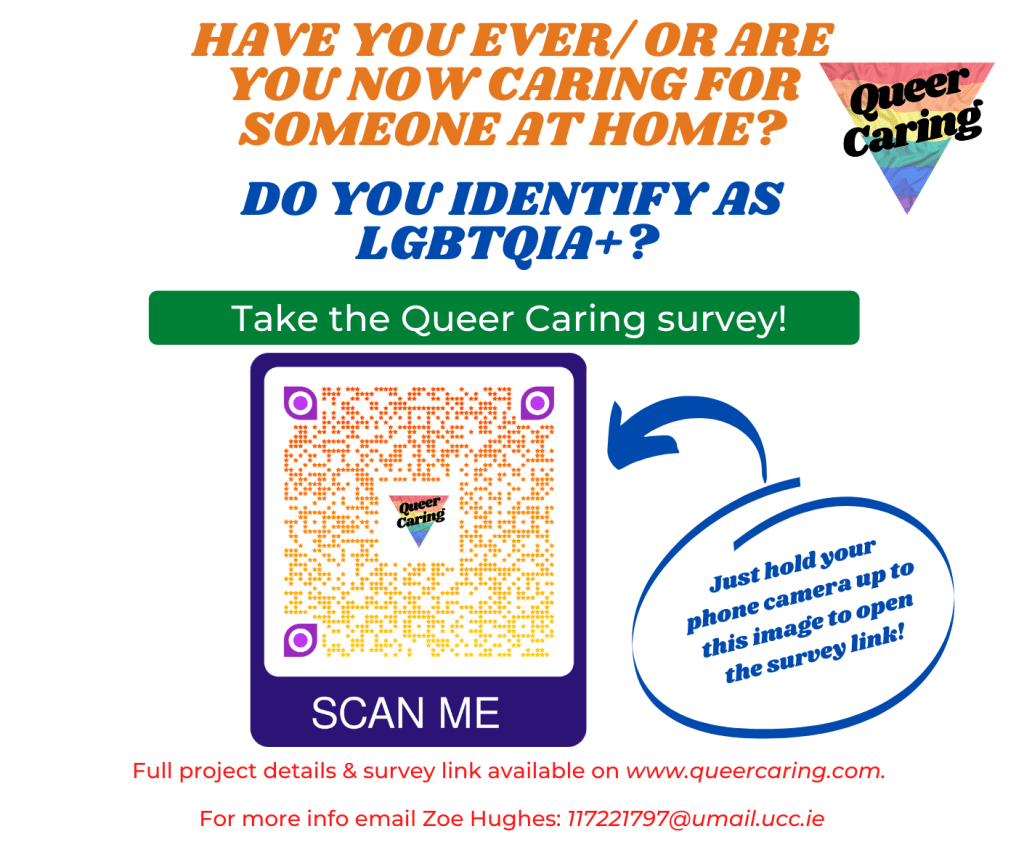
So keep an eye out for the link to the online survey to go LIVE during National Carers Week 2021 (which takes place from the 7th of June)
Throughout the process of this research study, I will be using this page to update participants and readers about the progress of the research. This will include discussions of terminology being used, details of any publications or presentations, and any other information which would be useful.
If you have any particular topic which you would like me to address, please email me: zoeghughes@gmail.com.