Phase 2 Data Collection!

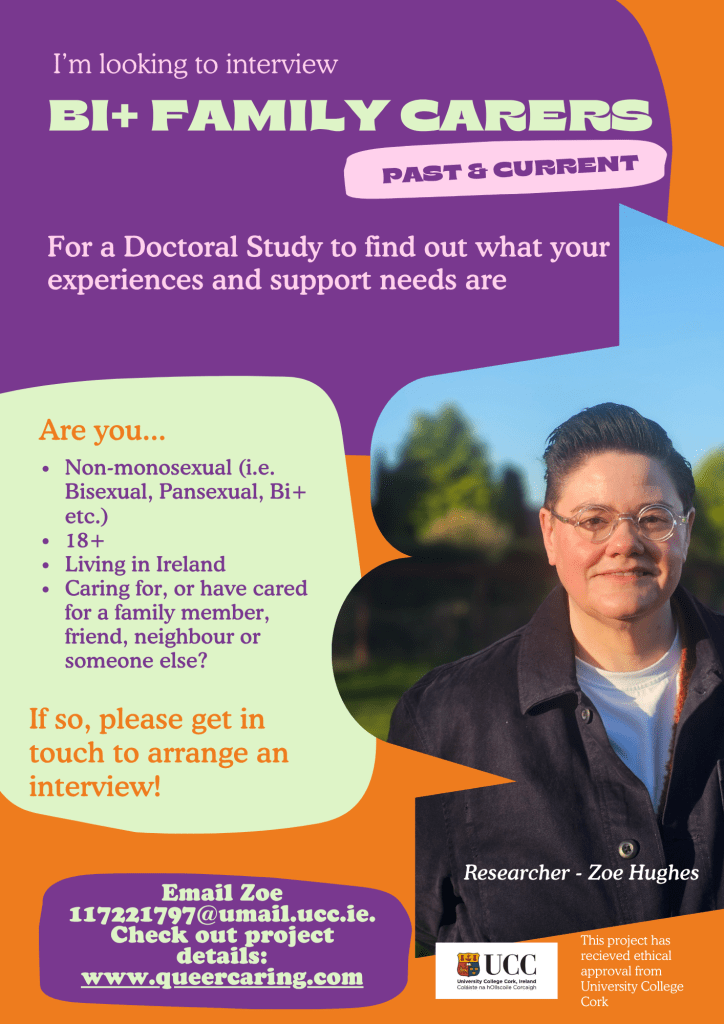
The time has finally come – it’s finally time to move on with my data collection, following Stage 1 quantitative data collection and analysis. I have received ethical approval from the UCC Social Research Ethics Committee (many thanks to the Committee for their review) and am now looking to speak to non-mono sexual family carers in Ireland (current and former) who are over the age of 18.

The reason I am choosing to focus on the experiences of family carers who identify as non-mono sexual is in part due to the significant lack of any research specifically pertaining to that experience – not only from an Irish perspective but internationally also. As of mid-2026 I have not located any family caregiving research which focusses on bisexuality, pansexuality, sexual fluidity or related identities. Most studies in this sector focus on lesbian and gay experiences of family care, with occasional passing mentions of non-mono sexuality.

So, if you meet the following criteria, I’d love to speak with you to explain more about the topic, my study, and perhaps to arrange an interview with you at your convenience either in-person or online. You can send me an email to 117221797@umail.ucc.ie, or by clicking through to my contact page here.

Are you:

  1. A current or former family carer? By that I mean, have you provided care and support to a person with additional care needs? Even though I use the word ‘family’ I don’t just mean blood family, or family of origin here. I also mean chosen family, friends, neighbours etc. They might have needed help due to a disability, a mental health concern, a physical/longterm health condition or addiction. This care might have happened in the past, or be ongoing now. It might be an older person you cared for like a parent; it might be your partner or spouse; it could be a friend; or it could be a child with additional need.
  2. Living and cared for the person in the Republic of Ireland? For this study I am focussing on the experience of those caring for people in the 26 counties of the Republic of Ireland. This is because the topic has never been researched here, and because the Health & Social Care systems in Northern Ireland are very different. You don’t have to be Irish to take part – but the care you provided needs to have been provided primarily in Ireland.
  3. Are you over the age of 18? I am looking to speak with adult family carers for this project. That doesn’t mean that if you were a young carer you cannot take part – I’d love to speak with you. For ethical reasons, all participants in this research must be over 18 when the interview takes place.
  4. Do you identify as non-mono sexual? By that I mean that you are attracted to more than one gender. Some of the terms people use for themselves are bisexual; bi+; pansexual; sexually fluid and others.

If you know of someone who you think might be interested in taking part, please share this page with them, or indeed my study poster below.

Non-Monosexuality and Care

Back again – and from the broad topic of ‘sexuality and family care’ comes a more narrow focus for the remainder of this project; looking specifically at non-monosexuality and family care.

What exactly is ‘non-monosexuality? Well, it’s a broad label for someone who is sexually or romantically attracted to more than one gender. Traditionally known as ‘bisexuality’, it essentially was being attracted to both men and women. Now, as our understanding of gender has expanded, and more people find themselves identifying in different gendered ways, this definition has widened, and includes common labels and self-identification using terms like bisexuality, pansexuality, sexually fluid and others.

Even as there is relatively little research and understanding within the health & social care sector regarding the experiences and support needs of sexual minorities in gender, what research as taken place typically focusses on lesbian and gay family carers, with bisexual or other sexualities only briefly mentioned, if at all.

Likewise, in the first phase of my research project, a significant number of responses came from non-mono sexual individuals, many of whom had a different caring profile than one typically might expect from sexual minority carers, and that have been written about before this. Many are in heterosexual relationships, caring for a child with additional needs or disabilities. The topic of biphobia both from the health & social care sector and the LGBTQ+ community came up many times. Experiences of bi-erasure, particularly within family and health & social care was a big issue for respondents, and how that changes the care experiences.

So, in order to investigate that further, I plan to conduct some interviews with non-monosexual family carers (both current and former), living in Ireland, regardless of current relationship status, gender, etc. I want to find out what their experiences are like of accessing supports, their experiences of biphobia or bi-erasure within their communities of family care and the LGBTQ+ community.

I will soon be recruiting for these interviews – if you are interested to take part when I have received ethical approval from my University, you can get in touch here.

Sexuality & Social Work Conference 2025 – My Presentation

Well that’s another one in the books!

It was wonderful to present my Doctoral work once again at the Sexuality & Social Work Conference in the beautiful city of Ljubljana, Slovenia in early July 2025.

The Triple Bridge, Ljubljana

Whilst it was hotter outside than I have ever experienced (I think the max it hit when I was there was 36 degrees!), the 2 days of the conference was full of very cool people and very cool research.

Seeing the diversity within the programme was incredible, and the choice of which parallel session to attend was very difficult.

I was pleased to present on the first day, with a presentation titled Queer Caring: Irish LGBTQ+ Family Carers and their Service Experiences.

if you’re interested to read the contents of my presentation, you can download a copy here.

I’m already looking forward to the next one!

Social Work & Sexuality Conference, 2025

I’m looking forward to presenting at the upcoming Social Work & Sexuality Conference in Ljubljana, Slovenia on July 2nd and 3rd 2025.

My experience at the 2023 conference was amazing, and I’m looking forward to reconnecting with folks from all over the world, and presenting my paper: Queer Caring: Irish LGBTQ+ Family Carers and their Service Experiences. I’ll be presenting in Parallel Session 2.2: Queering & Decolonising Care on Wednesday July 2nd.

I have had a challenging 2 years both personally and with my studies – so this will be just the ticket to reignite the passion once again.

If you’re coming along to the conference, I can’t wait to meet you!

Sexuality & Social Work Conference 2025 – Abstracts Open

After a break for personal health reasons, I’m back at my studies, and excited to get on track to submit in 2025 – all things going well!

I wanted to quickly let people know that the Sexuality & Social Work Conference 2025 has opened for abstracts (see here).

My experience at the conference in 2023 was phenomenal, and I met so many people who I connected with and learned so much from. I’m excited to go to next years conference in Ljubljana, Slovenia, where hopefully I’ll get to present my Doctoral work as it comes to the point near to submission. I was honoured to win Best Scientific Poster at the 2023 conference so we’ll see what 2025 brings!

Social Work & Sexuality Conference 2023 pt 2

Well, I’m here at the Social Work and Sexuality Conference in Glasgow, and being surrounded by researchers and social workers who centre sexuality in their work is a wonderful thing!

I was delighted to present my poster for the conference this afternoon, and to get to chat to so many folks who were interested in my research. It can be very isolating to be a PhD student, especially one working and studying at the same time, without a defined space in your University. This connection with others just as passionate about LGBTQ+ justice and care is invaluable, so thank you to everyone who stopped by to chat!

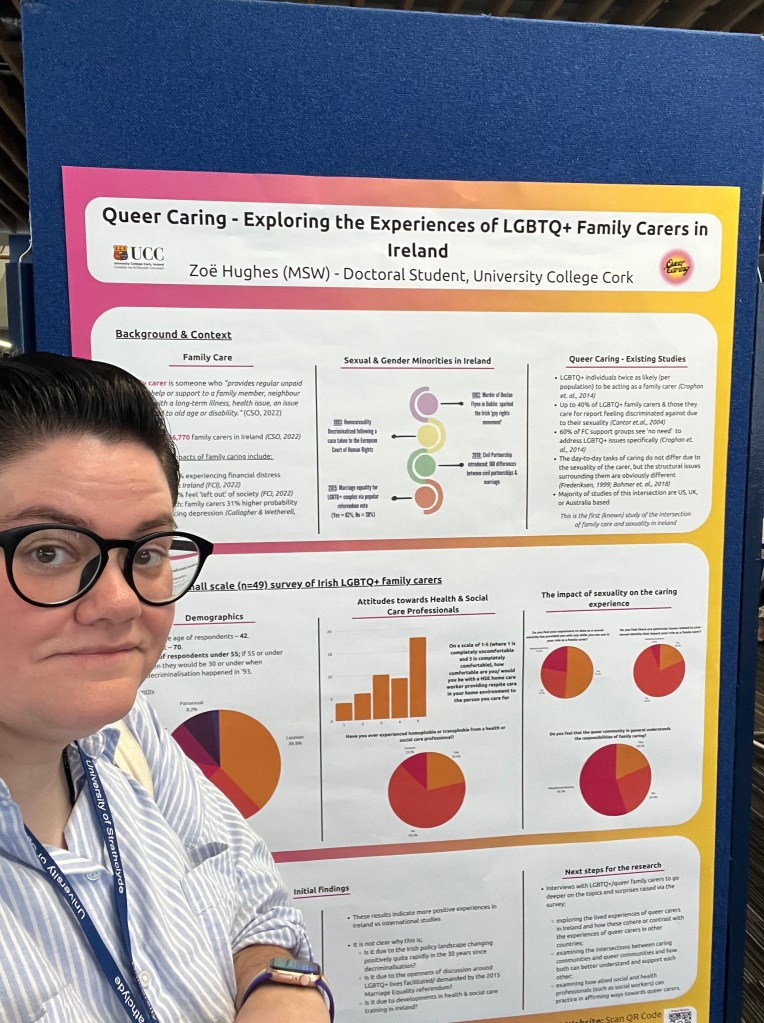
If you would like to download a copy of my poster, you can do so by clicking the image below.

If you’d like to get in touch about my research, or anything at all, you can get me through the contact form on this website, or follow me on Twitter: @zoeghughes.

Sexuality & Social Work Conference 2023

I am very excited to say that I will be attending the 5th International Sexuality and Social Work Conference: Everyday gender and sexuality: justice, rights and activism in social work and helping professions, taking place on 18th & 19th July at the University of Strathclyde, Glasgow.

Not only am I excited to attend, and to both get more immersed in the world of sexuality research and get back to my roots as a social worker, but I will also be presenting my Doctoral work in the form of a poster. It’s been a long time since I created an academic poster for a conference, and the last time I did one, Canva didn’t even exist!

So, if you’re attending the conference and you happen to see me do say hello! I’m excited to get to go to loads of relevant presentations (and probably some just for fun!) over the course of the two days I’ll be in Glasgow.

Data, data everywhere!

Yes, it’s been a while since the last update.

Yes, I said I’d update more regularly the last time I made a post.

Life gets in the way sometimes!

But, excitingly, I’m on to much more in-depth analysis of my survey data. That’s always the fun bit of any research project, when you start looking at what the people who have taken the time to take part in your research are saying. You start to see the issue in 3D again, after going back and forth in the literature. You see connections, links, things you were expecting, and even better – things you weren’t!

See Season 16 GIF by The Simpsons - Find & Share on GIPHY

From looking at the responses to the survey I conducted, I plan to develop an interview schedule to go deeper with a small number of interviews – so if you are or have been a family carer in the past, and identify as part of the LGBTQI+ community (however you define that yourself) and would like to take part in them, please do let me know. I’d love to talk with you.

Until next time!

July 2022 – Update time!

If you have been checking out this page, you might have seen I have not posted an update in quite a while.

As with everything, life happens to create challenges for all of us, and I am certainly no different. I have had a few health scares (both my own and some family members) to focus on, and so I took a leave of absence from my studies.

However, as of July 2022, I am back studying, registered on the part-time register. Balancing work, study, some caring responsibilities and my my own mental and physical health is a tricky business, as any family carer can certainly tell you better than I can!

Source: LabDucks

So, hopefully you should see some updates coming faster in the next little while.

I am currently working on the literature review for the project – hopefully I will soon post some of the most interesting papers and readings I have been working on reading and taking in. There’s quite a lot of them to get through, although relatively few (if any!) from an Irish perspective.

Until then, as always I’d love to connect with you if you are a queer/ LGBTQ+ carer, or an academic interested in the area. If you are none of those things and have an interest in the intersection of sexuality and care, don’t shy away either!

Language Matters Pt 2: Caring vs carer

You might have read my earlier blog post about the language I’m using in my research, where I discussed why I’m using the word ‘queer’ in the title of the research, and why I use it to describe myself. (If you haven’t read that – check it out here).

Almost as divisive and controversial is the use of the term ‘family carer’ or similar, used to categorise or define someone who supports and cares for a person in their own home. In an Irish context, the term ‘family carer’ seems to be the consensus over and above other terms used elsewhere such as ‘informal carer’ or even the arguably simpler ‘carer’ or ‘caregiver’. This is because here, often, people see the word ‘carer’ and assume someone who is paid a wage to provide care, perhaps via the Home Support Scheme or similar. By using the term ‘family’ alongside ‘carer’, the hope is that enough of a delineation is made – but of course that also means that if you’re caring for a friend or neighbour, you might not see yourself in that language.

Embracing the identity of family carer is often what enables someone to start to access supports for their caring journey – without fully understanding that you are a carer, and that you have your own needs, it’s easy to become overwhelmed, burnt out, frustrated and angry. These are totally natural emotional responses, but tapping in to the supports available – scant though they might be – can help alleviate some of these negative emotions and experienced.

In 2017, I published a paper in the International Journal of Care and Caring; Defining and profiling family carers: reflections from Ireland. That paper, although a few years old at this stage, discusses some of the points that must be taken into account when discussing the idea of language use and it’s relation to caring supports and services.

In this Doctoral study, as I am looking at the experience of queer carers, the use of the term ‘family’, can, in some cases, cause confusion. Do I mean only those who are caring for a parent, grandparent, child or other blood relative? Of course not. The idea of family of choice is paramount in the research, in particular when we look back to the AIDS epidemic in the 1980’s and 90’s, where gay men were often cared for and nursed not by medical professionals, but by members of our own community, by lesbians, bisexuals, trans men and women, and other gay men. Past lovers, friends, community elders, all came together to provide the care that was needed. To erase that from the concept of care within the queer community would be a terrible mistake.

So, when I use the term ‘family carer’, I am referring to anyone providing care or support for a disabled person, a person with a chronic illness, long term condition, addiction, or dementia. The care provided does not have to be ‘medical’ in nature, it does not mean you have to be washing and bathing and changing dressings or administering medication. It simply means that you provide a level of support in tasks and at a personal level above and beyond what could be expected of a similar relationship.

If you have any thoughts on this, I’d love to hear from you. And don’t forget, my survey is STILL open for responses – you can click here to get more information.